The Architecture of Essentialism: Why Sustainable Software Starts with Less Code
Discover why bridging the 'Code vs. Solution' gap and eliminating unnecessary software complexity drives business velocity, lowers cloud costs, and prevents tech debt.
In software engineering, there is a dangerous misconception that line count equals productivity. When organizations face operational bottlenecks, the default instinct is almost always to write more code, build new microservices, or integrate additional third-party dependencies. Yet, more code invariably creates more surface area for bugs, security vulnerabilities, and maintenance debt.
At Taatviks Tech, we approach engineering from a fundamental premise: The most sustainable code is the code you never had to write.
Bridging the gap between simply “writing code” and “delivering a business solution” is the core principle behind the Architecture of Essentialism.
Essentialism in Software
Essentialism in software engineering is not about minimalism for aesthetic reasons. It is about relentless focus on business outcomes. It means stripping away digital noise, artificial abstractions, and premature optimizations until only the core function remains.
When an engineer acts purely as a code producer, every problem looks like a requirement for a new feature or service. Conversely, when an engineer operates as a business-first Solution Architect, the goal shifts from generating lines of code to solving operational problems with the least amount of technical overhead.
Business-first architecture asks 3 non-negotiable questions before a single line of code is written:
- What precise business systems workflow are we enabling or accelerating?
- Can this problem be solved by simplifying the existing architecture or data flow?
- What is the total cost of ownership—including maintenance, infrastructure, and developer cognitive load—over a multi-year horizon?
True Cost of Unnecessary Code
Every line of code committed to a repository is a liability before it is an asset. While a new feature might deliver immediate utility, the long-term tax of unnecessary complexity compounds silently across three vectors:
- Compounding Technical Debt: Bloated codebases lengthen onboarding times for new engineers and turn minor refactoring tasks into fragile, high-risk deployments.
- Elevated Security & Compliance Exposure: Every superfluous package, API endpoint, or microservice increases your attack surface area and requires ongoing patch management.
- Inflated Infrastructure & Maintenance Costs: Unnecessary abstractions and redundant custom systems silently bloat operational expenses without providing proportional business value.
The Framework
To break free from the cycle of feature inflation, we apply a four-stage Solution Partner Framework designed to align engineering directly with business ROI.
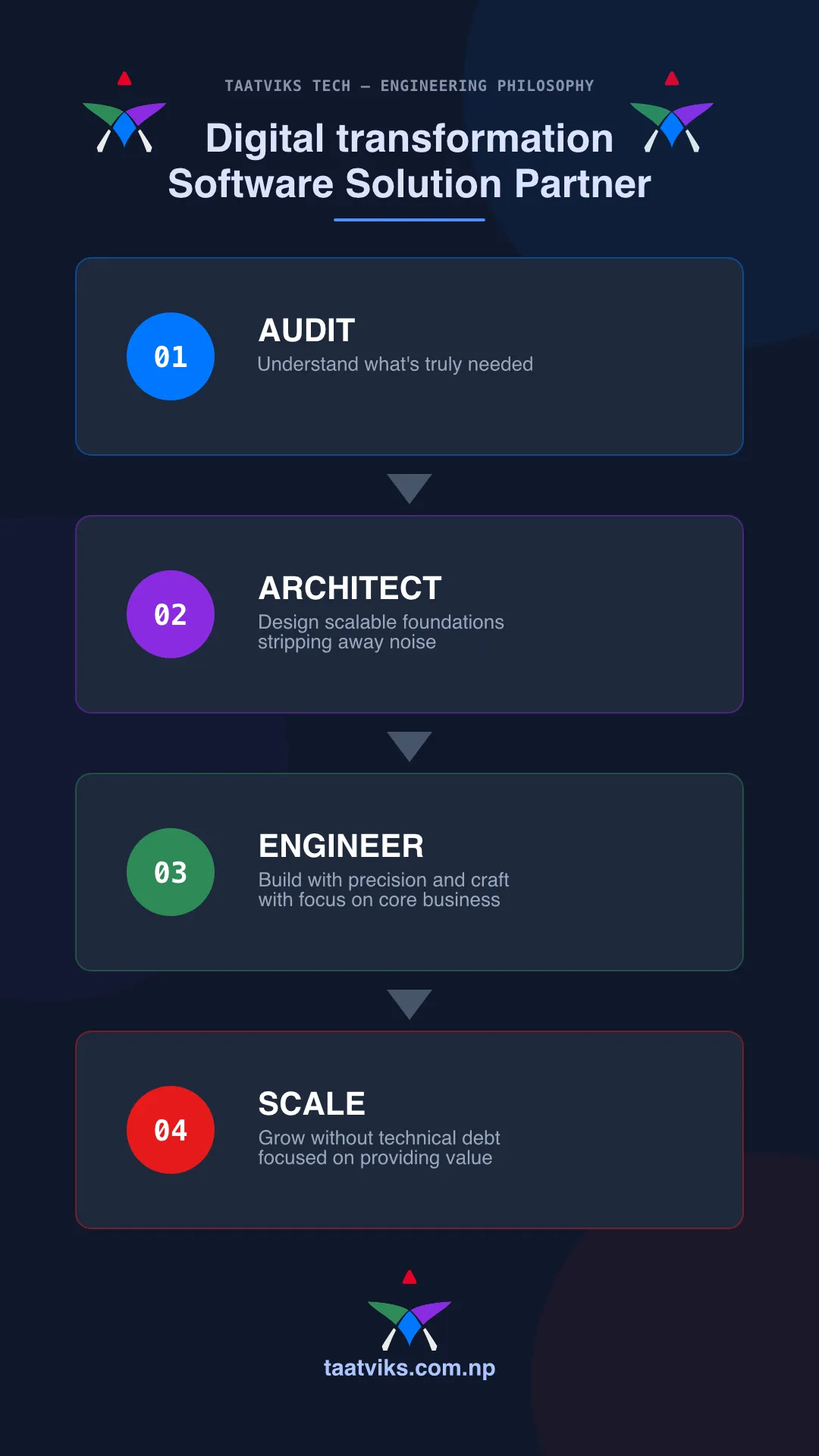
Stage 1: Process Mapping
Before proposing tech stacks or database schemas, we map the end-to-end operational process. We identify manual friction, data bottlenecks, and actual user needs rather than superficial feature requests.
Stage 2: Architecture & Data Flow
We design lean, resilient data pipelines and system boundaries. By establishing a clear strategy to define sources of truth and eliminating unnecessary middle layers, we ensure the system remains easy to reason about and maintain.
Stage 3: Lean Implementation
We engineer the solution using clean, strongly typed, and modular components. We prioritize maintainability, snappy execution, and minimal external dependencies.
Stage 4: Scale & Evolve
With a streamlined foundation, scaling becomes predictable and cost-effective. Systems can evolve without requiring massive ground-up rewrites.
Enterprise Scenario: Process Mapping Over Custom Code
A chartered accounting firm approached us with a growing operational bottleneck. Individual team members were relying on disparate self-management tools, leaving project statuses fragmented and task priorities unclear across the organization. This lack of visibility created severe information synchronization issues, particularly during peak client reporting periods.
The company’s initial instinct was to develop a custom central management platform from scratch to track all business operations. However, the projected capital expenditure and long-term maintenance overhead of custom software did not make sound business sense.
As a business-first solution architect, we evaluated their underlying workflow before committing to any software development:
- The Diagnosis: The root issue was operational opacity and fragmented communication—not a missing proprietary software stack.
- The Solution: Instead of writing thousands of lines of unneeded custom code, we restructured their workflow and configured an existing set of enterprise software tools around a centralized Kanban-style management system.
The Outcome: The firm achieved complete cross-company visibility and task alignment in weeks rather than months. Efficiency and workflow clarity increased significantly—all while saving substantial capital and completely eliminating the burden of custom software maintenance.
Ready to Simplify Your Technical Footprint?
Building high-impact software doesn’t require endless complexity—it requires architectural clarity. If your team is struggling with creeping cloud costs, slow delivery cycles, or brittle legacy systems, a business-first technical audit can illuminate the shortest path to sustainable performance.